Carbon Neutrality by 2050
Our initiatives toward sustainability and business activities
Since the early 2000s, we have been a pioneer in environmental measures and global warming prevention, starting with zero flaring of flue emissions in Abu Dhabi, United Arab Emirates, and continuing with the CDM project in Vietnam.
Middle East's First
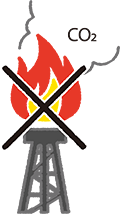
In 2000, oil production has commenced using a method that significantly reduces emissions of CO2 and hydrogen sulfide by injecting sour gas underground instead of incinerating it.
This has substantially cut down on flaring and is the first time in the Middle East.
World's First
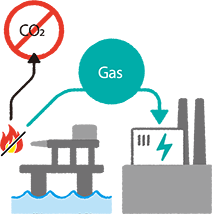
In 2007, the Rang Dong oil field in Vietnam has become the first in the oil development industry to receive CDM* certification.
- CDM: Clean Development Mechanism, a resource development that significantly reduces CO2 emissions compared to conventional methods.
World’s Largest
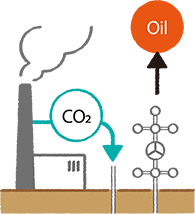
In the US, we have commercialized the Petra Nova CCUS Project, which separates and captures CO2 from glue gas and injects it underground. It is one of the world's largest CCUS projects, achieving to have captured 5 million metric tons of CO2.
Japan's First
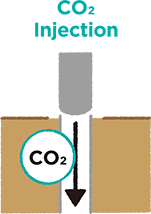
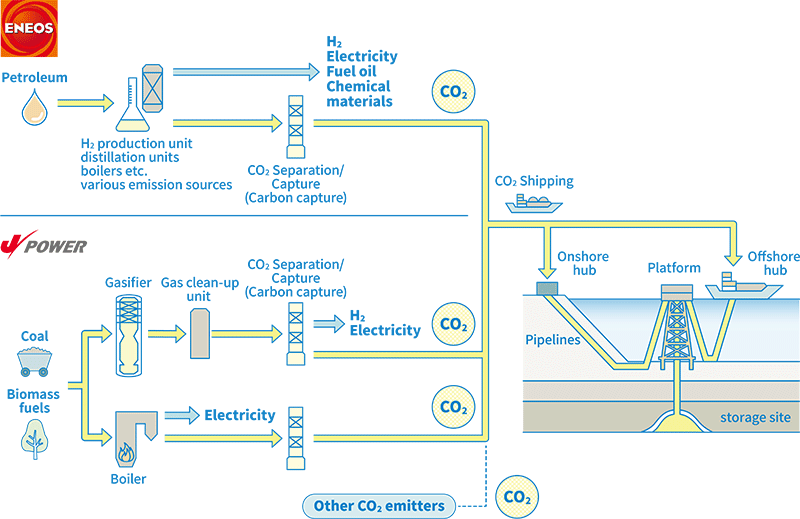
Aiming to be one of Japan's Advanced CCS projects targeting CO2 injection in the early 2030s, we are accelerating concrete study to achieve an injection of 1.6 million tons of CO2 per year off the coast of Western Kyushu area.
CCS / CCUS Projects
USA Petra Nova CCUS Project
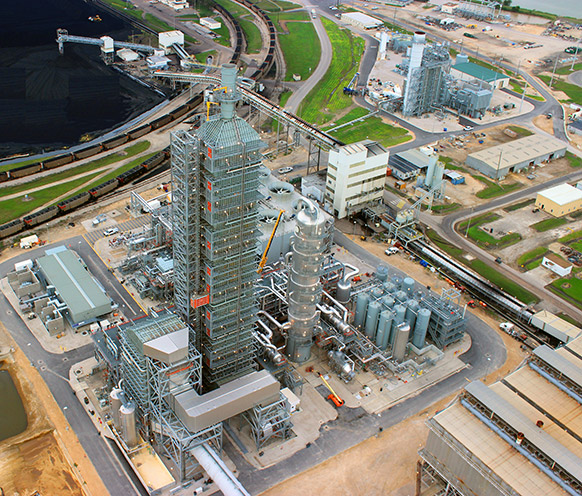
We are implementing a project that will simultaneously achieve a dramatic increase in production from aging oil fields and cut atmospheric CO2 emissions in Texas, USA.
Through it, we capture CO2 emitted from a coal-fired power station and injected it into an oil field with declining production. This allows us to increase the oil field's daily production significantly and also reduce the amount of CO2 emitted into the air.
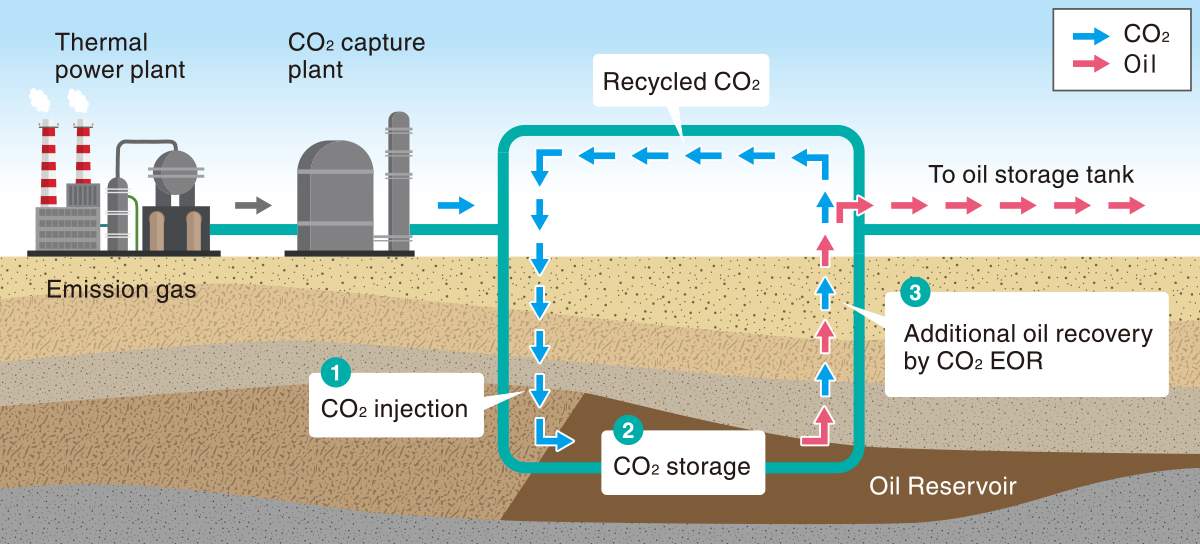
The CO2-EOR (Enhanced Oil Recovery) technology used here improves oil field productivity by injecting and storing CO2 in the ground.
Our project is oriented toward commercialization that makes use of CO2 emitted from a coal-fired power station, and for this it was recognized as a particularly advanced undertaking by the Clean Coal Power Initiative program in USA. As such, it became eligible for a 195-million-dollar grant from the U.S. Department of Energy. It began commercial operation in December 2016 and commenced oil field production based on increased production and capture in February 2017. With a yearly capture capacity of about 1.4million metric tons of CO2, the project operates as one of the world's largest plant that captures CO2 from flue gas.
The CO2-EOR Mechanism
Malaysia BIGST Project
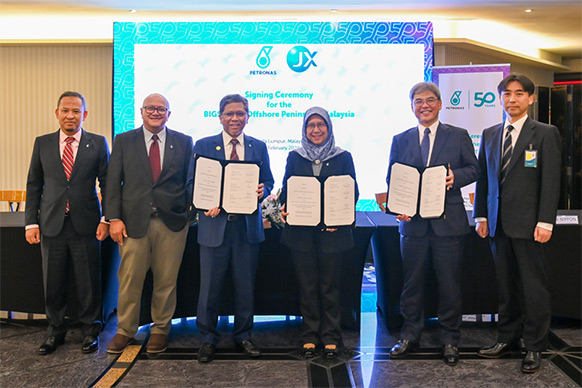
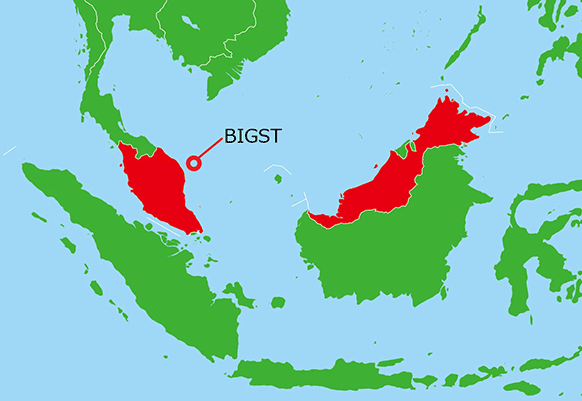
We have signed a Production Sharing Contract ("PSC") with Petroliam Nasional Berhad ("PETRONAS") and PETRONAS Carigali Sdn. Bhd. ("Carigali") for the development and production of the Bujang, Inas, Guling, Sepat and Tujoh ("BIGST") fields offshore Peninsular Malaysia in February 2024.
In addition, we have signed a Joint Operating Agreement (JOA) with the BIGST Operator, Carigali.
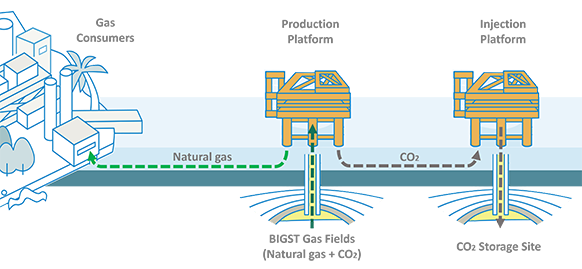
BIGST has an estimated recovery of approximately 4 trillion standard cubic feet (Tscf), it has not been developed until now due to the high concentration of CO2 along with gas.
We will utilize CCS technology to separate and recover CO2 produced with natural gas and inject it into a depleted gas field nearby, making this a model case for a new era of petroleum and natural gas development business combining a conventional natural gas development with an environmental solutions business.
As an active partner, we will proceed with PETRONAS and Carigali to contribute to the increase in gas supply in Malaysia and work towards the realization of carbon neutrality through CCS implementation.
Japan Advanced CCS Project
We are jointly working on a feasibility study for large-scale CCS in Japan to reduce CO2 emissions with ENEOS Corporation and J-POWER.
Three companies are conducting exploration and evaluation to select candidate sites for CO2 storage in western Japan with the aim of starting CO2 injection in the early 2030s. In February 2023, a joint venture named West Japan Carbon dioxide Storage Survey Co., Ltd. was established to accelerate preparations for the commercialization of domestic CCS.
We aim to contribute to the achievement of Japan's greenhouse gas emission reduction targets while ensuring stable energy supply by implementing Japan's first full-scale CCS value chain in the early 2030s.